My parents were (and my mother still is) very social people. It wasn’t unusual for us to have between 10 to 30 guest any given week-end. Our house was perpetually opened to anybody willing to visit. Of course, in our traditionnal moroccan life-style, calling bofore-hand to announce a visit wasn’t required. And of course, if you came at our house, announced or not, my parents would have took it almost as an insult if you refused to have at least tea or coffee, accompanied by a large assortment of pastries and one cake of some sort.
Hospitality in Morocco is a natural thing and is always very warm and generous. But it is also an act filled with protocoles which govern both the host and the guest attitudes and communications. You probably would be bored to know all the details about the hospitality protocoles in our family. I’ll spare you that ! (Aren’t you relieved ?!)
If we were in Morocco, we would gather once every other week or so several women of the family and/or neibourhood in a pastry spree, chatting and gossiping all the way through the pastry making day. In a single afternoon, with a team of 4 to 8 women, we would have made thousands or delicate and complicated little cookies and other delicacy. At the end of the day, each woman would have gone home with her share of the bountiful fragrant production to offer her guests in the coming week or two.
But we were living in France. So help was not so easily granted. We did, my sisters and I, spend the night up and making pastries countless times. Exhausting! But it was also such a good way to bond together. I have precious memories of my sisters and I slaving all night over traditionnal moroccan pastries, and less precious ones about falling asleep in the middle of the algebra class !
Chebbakia
This is not a particularly difficult recipe to make but I highly recomment to work with someone to do it. It’s better to be two persons because you need to dip the pastries in honney immediately upon removing them from the frying oil. Then it’s not recommended to let them swim in the honey, you have to remove them pronto to put them in a sieve a minute or two for the excess honey to drip. Then you have to immediately sprinkle with sesame seeds because if you wait the seeds won’t adhere well to the pastries.
All this happens in less than 1 minute laps of time and you have to keep in mind you need to be watching and turning those pastries frying while you honey and sesame those already fried. So I recommend you make the dough and form it with your pal, then when all the dough is formed, one person takes care of the frying and the other of the honeying and sesame sprinkling.
I worked alone, and even with my 25 ++ years of experience, I had a hard time rushing on my chebbakias.
It’s so much fun to make pastries with a friend or a loved one. Oddly, we never, ever had fights my sisters and I while teaming up for pastry making. We rather had a blast giggling and chatting.
About 6 cups (1 kg) all purpose flour
2 eggs
¼ cup + 2 tablespoons unsalted butter (actually I weight 125 g butter)
1/4 cup vinegar (I use cider vinegar)
1/4 cup olive oil
1/4 cup anise powder
1 cup and a 1/4 sesame seeds (200 g)
1/3 a cup orange blossom water
1 cup water
1 teaspoon quick rising yeast
1 teaspoon baking powder
Few saffron threads (optional)
Vegetable oil suitable for frying
For after you fry the pastries:
3 cups (250 g) honey
2 tablespoons orange blossom water
4 tablespoons sesame seeds
¼ teaspoon salt
First, lay the sesame seeds intended for the dough on a cookie sheet and toast them until slighly golden in a 350 F oven (watch them so they don't burn!). Let them cool totally and then crush them in a food processor or in a coffee grinder. To make the dough by hand
Put the saffron in 3 tablespoons of warm water took out from the cup of water you will use for the dough. Set aside for 5 minutes then remove the threads and discard them. Put the saffroned water back in the main cup water.
In a large bowl, mix well together water, eggs, vinegar, olive oil, butter, anise powder, orange blossom water and the toasted powdered sesame seeds.
Add 4 cups of the flour and incorporate well in the wet ingredients. Add both quick rising yeast and baking powder and continue to mix. Add the rest of the flour little by little while kneading until you obtain a dough which no longer sticks to your hands (you may not need the entire amount of flour or you may need more than the amout the recipe calls for).

The dough not only shouldn’t stick to your hands anymore but it also has to be the texture of kid’s playdough. Malleable yet somewhat sturdy.
To make the dough using a kitchenaid

In your kitchenaid bowl, mix well together water, eggs, vinegar, olive oil, anise powder, orange blossom water and the toasted powdered sesame seeds.
Using the dough hook, mix in 2/3 of the flour and add baking powder and yeast.
Add the rest of the flour,1/2 a cup at a time, until you obtain a play-dough like dough.
Shaping the chebbakia
Separate the dough in balls the size of an orange. Let rest, covered with a kitchen towel, for 30 minutes before shaping.
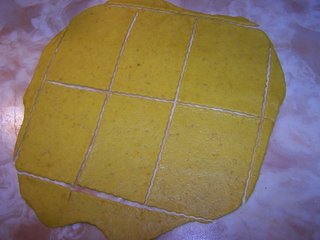
Take each ball of dough and roll it out in a 1/4 of an inch thickness.
It’s tricky to explain ho wto shape. Let’s say the main rule is to have a dough rolled less than1/4 of an inch thick.
Then make squares of entrelaced bands of dough. Here are the pics of the shaping.
 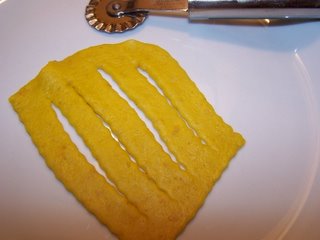 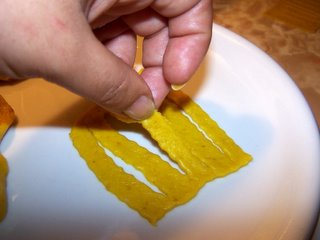 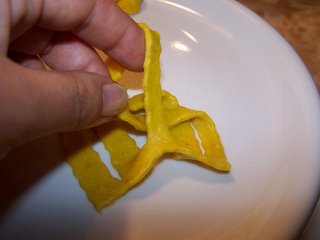 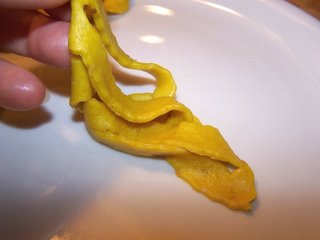
Make sure you shape all the chebbakia before heating your frying oil and begin to fry them.
In a saucepan, heat on very low heat the honey with the orange blossom water. Once warm, remove from heat.
Prepare a sieve over a bowl in which the honey-dipped chebbakia will drain for 1 minute.
Frying and honeying the chebbakia
Heat oil in a fryer (I don’t own an electric one so I don’t know how one can fry chebbakia in those).
Put several shaped chebbakias in it and fry, turning them once, until golden brown on both sides.
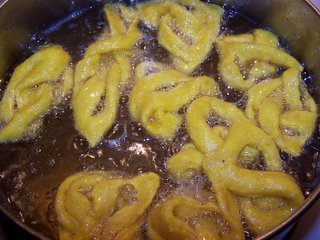
Immediately submerge each fried pastry in the honey. Make sure it has honey all over but don’t let the pastry stand in the honey.
Remove the pastries from the honey and put to drain in the sieve for half a minute or so.
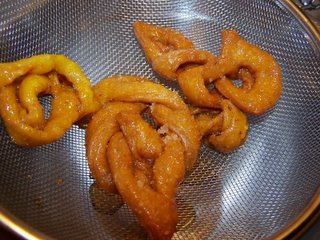
Put the honeyed pastries on a large platter and sprinkle immediately with sesame seeds.
Chebbakia keeps at room temperature up to 2 weeks. Just cover it with aluminium foil or keep it in a pot with a lid.
Bon appétit !
|


4 comments:
I'm not sure those sound good, best to send me a week's worth as a sample first.
Grin, thanks again for a marvellous new recipe. I must quit reading you at work, though.
he he he he.....
Oh my gosh, I have been looking E V E R Y W H E R E for this recipe! For some reason I keep finding it in French! LOL thanks so much I can't wait to make it and I'll let you know how it turns out. Btw, how many does this make?
I got back from maroc last year, and have been desperately searching for this and for the recipe for sfouf- everyone said it was hard to make... ideas? Thanks!
Post a Comment